Planster vs Atomic Supply
Atomic Supply is a well-funded, ex-Tesla-built planning tool with real scenario and versioning capabilities. Planster is a decision-first demand-planning platform for $10–50M consumable CPG that adds what Atomic doesn't: a retail-deal pipeline, a pre-commit capital gate, a proactive agent, and transparent flat pricing.
The short answer
No tool wins for everyone. Here's the honest split.
CPG brands who want a pre-commit capital gate on every scenario, a retail-deal pipeline, a proactive overnight agent, and pricing they can see on the website.
Early-adopter brands with concentrated SKU bases in 1–2 distribution centers who want a scenario-and-forecasting tool from an ex-Tesla team and are comfortable with enterprise, quote-based pricing.
Feature-by-feature
| Capability | Planster | Atomic Supply |
|---|---|---|
| Scenario planning | Sandboxed scenario layers, compared side by side | Genuinely supported — build and compare scenarios with financial deltas and versioning |
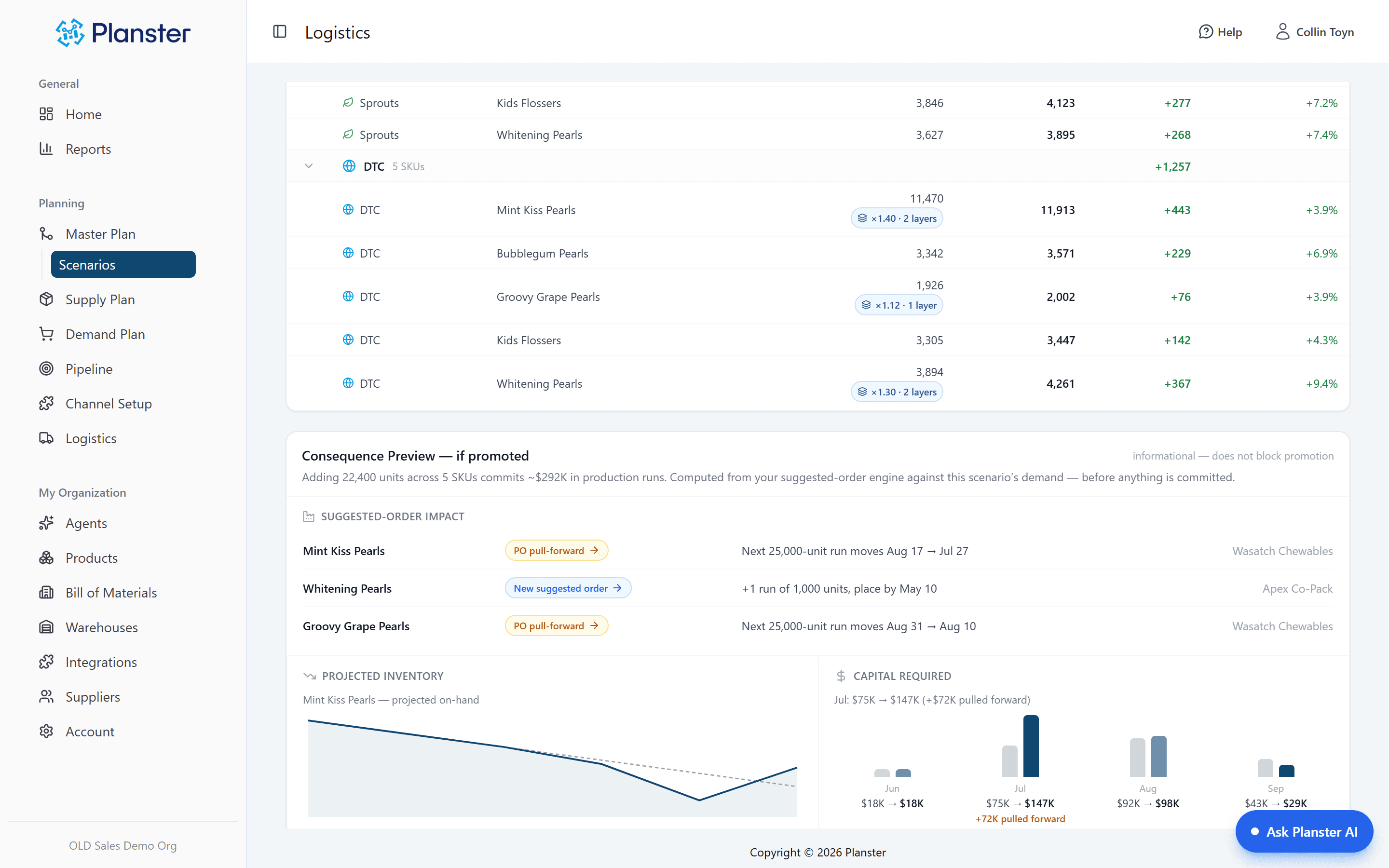
| Pre-commit capital gate + promote/un-promote | See the exact PO + capital a scenario commits (~$292K) before you promote; promote with full history and un-promote to undo | Version-compare exists, but no pre-commit "capital-at-risk before you promote" gate |
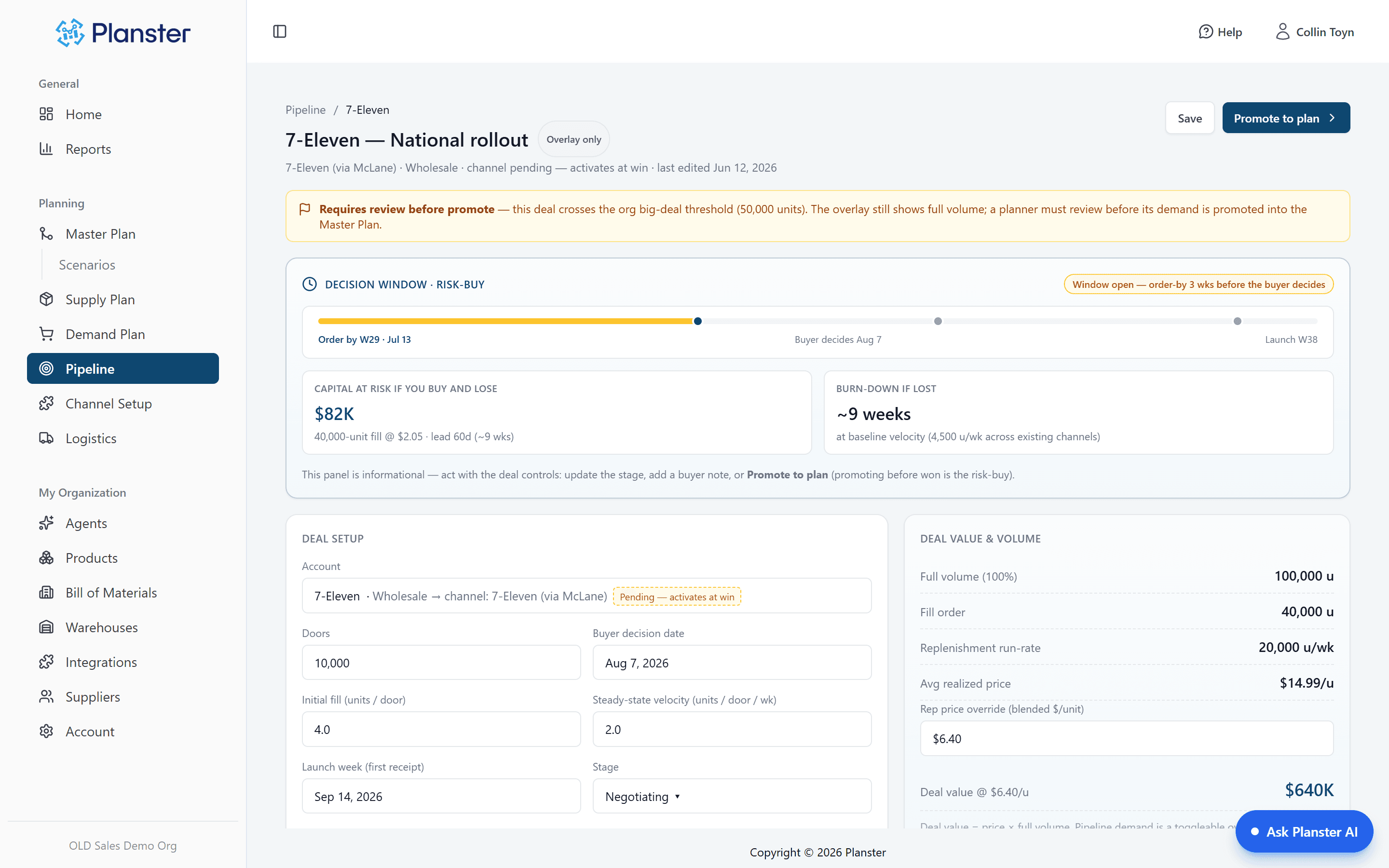
| Retail-deal pipeline → demand (risk-buy math) | Deals overlay the plan at full volume with order-by dates and capital-at-risk math | No retail-deal or sales-pipeline planning |
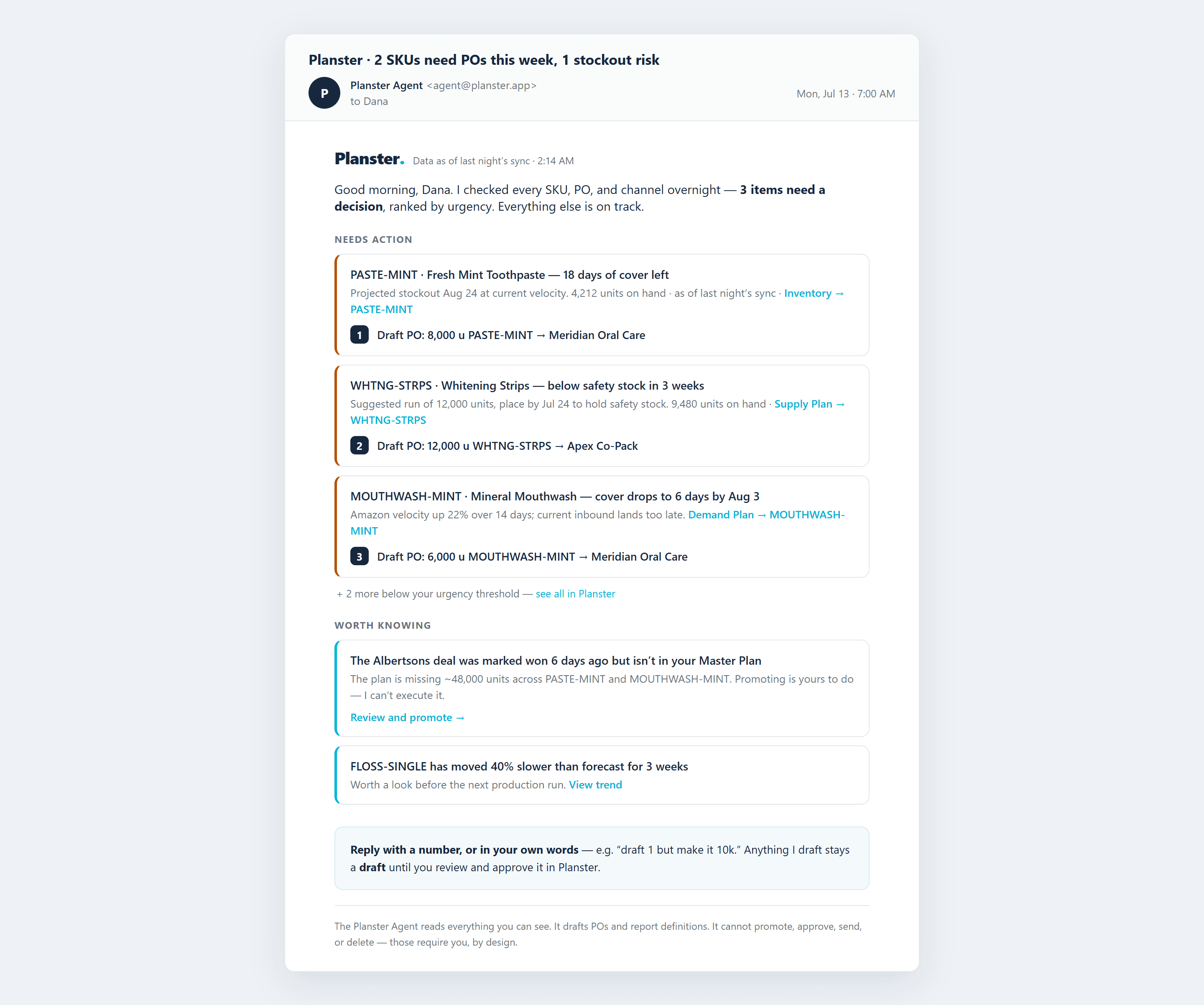
| AI agent | Proactive overnight scan → ranked digest you receive without asking | "AI Companion" is a pull tool you query; human-in-the-loop, draft-only (same safety posture) |
| Multi-warehouse / omnichannel scale | Multi-warehouse, multi-3PL, multi-channel from one plan | Nightly batch; positioned best for concentrated SKUs and 1–2 distribution centers |
| Onboarding & bolt-on setup | Connect data, first insight in minutes, running in days | Comparable — data in ~24h, no-code, 50+ integrations |
| Pricing transparency | Flat ~$1,000/mo, published | No public pricing — enterprise-tier, "comparable to legacy suites," quote-based |
Where Planster pulls ahead
See what a decision costs before you commit
Planster's Master Plan runs every what-if through your real ordering engine and shows the consequence — which POs move and how much capital the change pulls forward — before you say yes. Most planning tools tell you what to reorder; Planster tells you what a whole scenario commits.
Plan the retail launch, not just the reorder
Planster's Pipeline treats retail deals as living demand: a deal overlays your plan at full volume and does the risk-buy math — the order-by date to hit the launch, and the capital at risk if it falls through. That founder-level "do I buy before the buyer decides?" question is one a reorder tool never answers.
The grunt work happens overnight — the decision stays yours
Every night the Planster Agent checks every SKU, PO, and channel and emails a ranked morning digest with draft POs attached. Reply in plain English to draft; approve in the app. It cannot promote, approve, or send on its own — by design.
Pricing
Flat ~$1,000/month, published on the site, everything included.
No public pricing anywhere — positioned as enterprise-tier ("comparable investment to legacy suites") and sold by quote. Expect a sales process before you see a number.
Atomic Supply pricing is not published; assessment from their site and third-party reviews, 2026-07-23.
When Atomic Supply is the better fit
No tool wins for everyone. Here's where Atomic Supply is the honest choice.
- You have a concentrated SKU base in 1–2 distribution centers and want a forecasting-plus-scenario tool from an ex-Tesla team.
- You're comfortable with enterprise, quote-based pricing and a sales process.
- You don't need retail-deal planning or a proactive overnight agent.
Common questions
Does Atomic Supply do scenario planning?
Yes — Atomic genuinely supports scenarios and versioning with financial deltas. The difference is Planster's pre-commit consequence preview (see the ~$292K a scenario commits before you promote it) and an explicit promote/un-promote gate, plus a retail-deal pipeline Atomic does not have.
How is Planster's AI agent different?
Both keep a human in the loop and draft-only. Atomic's AI Companion is a pull tool you ask; Planster's agent is proactive — it scans every SKU, PO, and channel overnight and sends you a ranked digest without being asked.
Scenarios are table stakes. The commit gate isn't.
See the capital a decision commits before you promote it — and get pricing without a sales call.