Planster vs Settle
Settle is a strong AP-automation and inventory-financing platform that added planning. Planster is a purpose-built demand-planning platform for $10–50M consumable CPG — deep forecasting, scenario consequence previews, a retail-deal pipeline, and a proactive agent, with no loan book shaping the advice.
The short answer
No tool wins for everyone. Here's the honest split.
CPG brands who want deep, steerable demand planning — scenarios, a retail-deal pipeline, S&OP, and a proactive agent — with recommendations that aren't shaped by a lender.
Brands who primarily want bill-pay/AP automation and inventory financing in one place with clean UX, and treat demand planning as a secondary need.
Feature-by-feature
| Capability | Planster | Settle |
|---|---|---|
| Primary purpose | Demand planning — decide what to buy, when, and why | AP automation + inventory financing first; planning is a secondary add-on |
| Planning depth | Steerable forecasts, scenario planning, S&OP, reorder logic | Forecast auto-selects a model with no user-steerable surface; reviewers note it's "still developing" |
| Scenario planning with consequence preview | Sandbox what-ifs; capital preview before commit; version history + un-promote | None |
| Retail-deal pipeline → demand (risk-buy math) | Deals overlay the plan at full volume with order-by dates and capital-at-risk math | None |
| AI agent | Proactive overnight digest; reply-to-draft POs with provenance | "Tally" is a copilot that can draft POs; not a proactive overnight agent |
| Inventory financing | Not a lender — plan in Planster, finance POs through any lender | Settle Working Capital lends $20K–$15M, often funded in under 48 hours |
| Advice independence | Recommendations aren't shaped by a loan book | Forecasting lives inside a lending business — recommendations may favor financed POs |
Where Planster pulls ahead
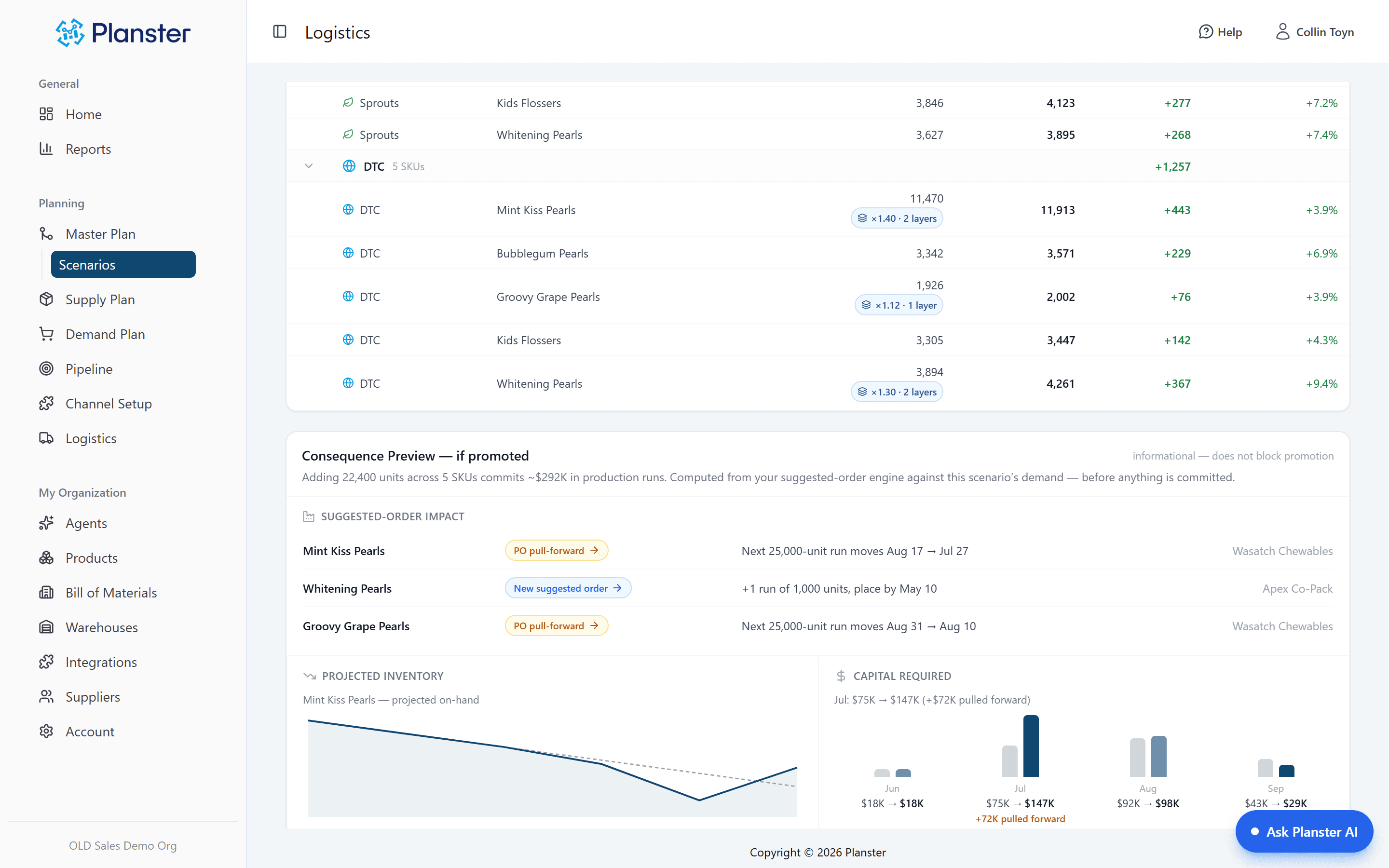
See what a decision costs before you commit
Planster's Master Plan runs every what-if through your real ordering engine and shows the consequence — which POs move and how much capital the change pulls forward — before you say yes. Most planning tools tell you what to reorder; Planster tells you what a whole scenario commits.
Plan the retail launch, not just the reorder
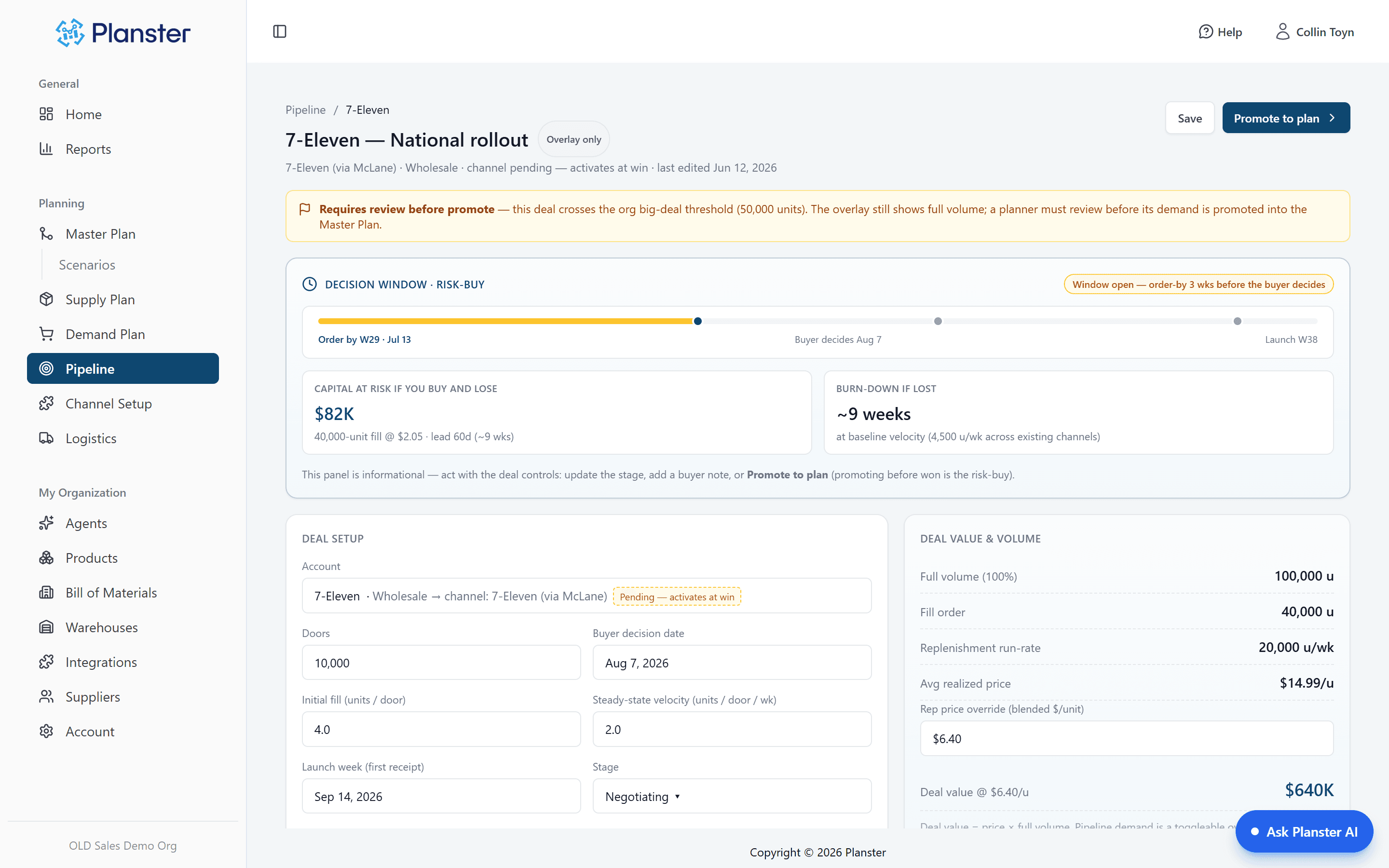
Planster's Pipeline treats retail deals as living demand: a deal overlays your plan at full volume and does the risk-buy math — the order-by date to hit the launch, and the capital at risk if it falls through. That founder-level "do I buy before the buyer decides?" question is one a reorder tool never answers.
The grunt work happens overnight — the decision stays yours
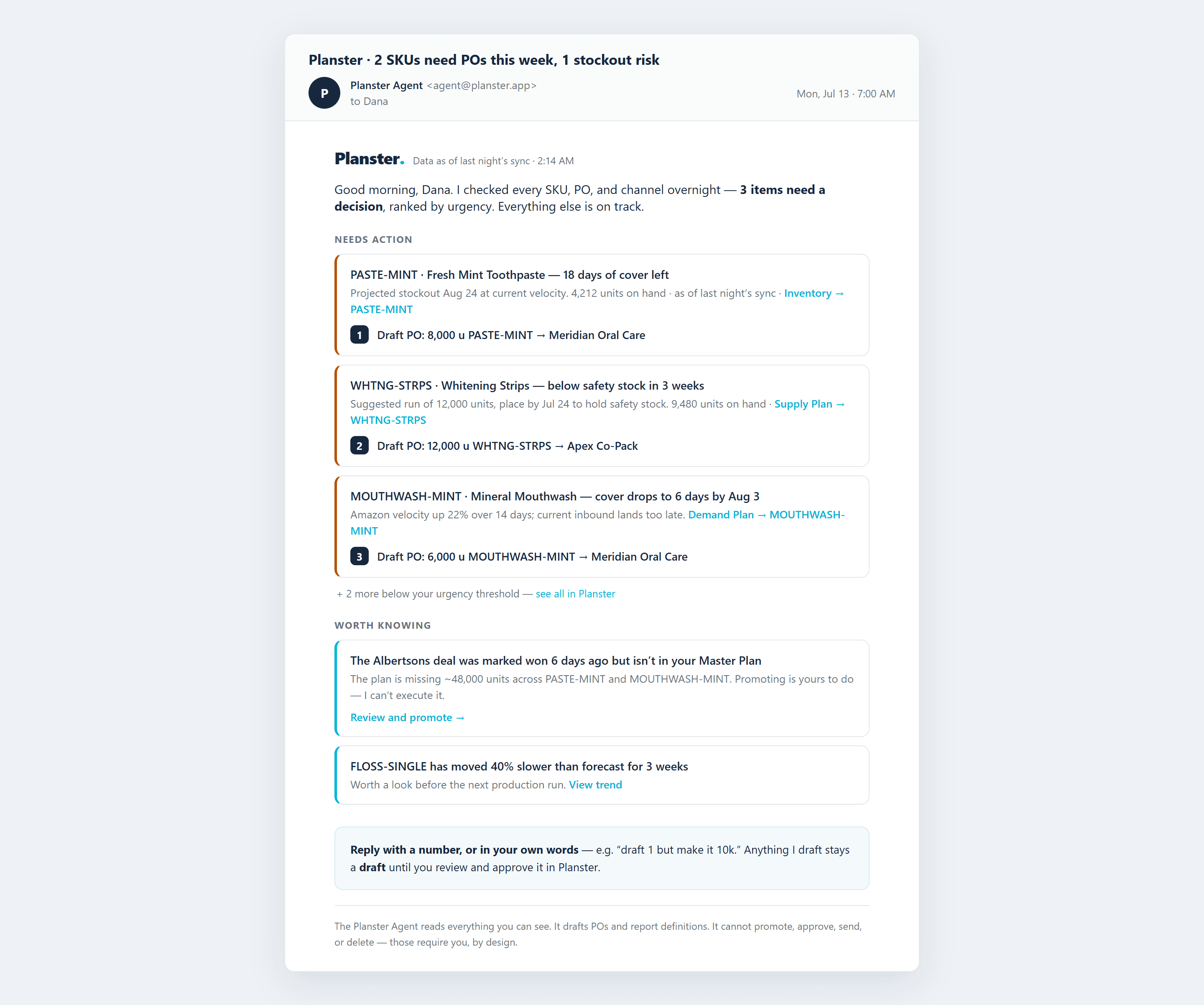
Every night the Planster Agent checks every SKU, PO, and channel and emails a ranked morning digest with draft POs attached. Reply in plain English to draft; approve in the app. It cannot promote, approve, or send on its own — by design.
Pricing
Flat ~$1,000/month for planning, everything included.
SaaS tiers are cheap (Free / $199 / $499/mo) because the real monetization is financing — Settle Working Capital lends $20K–$15M at roughly 1.4%/month (~17% APR by their own example). Planster is flat $1,000/mo for planning, with no loan book behind the recommendations.
Settle pricing and financing terms verified against settle.com, 2026-07-23.
When Settle is the better fit
No tool wins for everyone. Here's where Settle is the honest choice.
- You mainly want AP automation and inventory financing (working capital, extended terms) in one platform.
- You value their clean UX and treat demand planning as a secondary need.
- You can plan in Planster and finance POs through Settle or any lender of choice.
Common questions
Can Planster finance my inventory like Settle?
No — Planster is a planning platform, not a lender. You plan in Planster and finance POs through your bank, Settle, or any lender. The upside: Planster's recommendations aren't shaped by a loan book, so the advice is about what's right for your inventory, not what's financeable.
Is Settle's demand planning as deep as Planster's?
Settle's forecasting is newer and auto-selects a model with no user-steerable planning surface — their own reviewers note the inventory features are "still developing." Planster is purpose-built for demand planning, with scenarios, S&OP, and a retail-deal pipeline.
Planning first, financing wherever you like
See demand planning built to decide what to buy — with no lender shaping the recommendation.