Planster vs Inventory Planner
Inventory Planner (now "by Sage") is a mature, established forecasting-and-reorder platform used by 2,600+ brands. Planster is a decision-first demand-planning platform for $10–50M consumable CPG brands — with scenario consequence previews, a retail-deal pipeline, and an overnight AI agent, all on top of the same forecasting engine.
The short answer
No tool wins for everyone. Here's the honest split.
Consumable CPG brands ($10–50M) who want to test big moves before committing capital, plan retail launches against real supply, and let an agent do the overnight grunt work — on a simple, predictable flat price.
Established multi-channel retailers (apparel, beauty, furniture) who want a mature, broad platform with a large report library and Open-to-Buy budgeting, and don't mind pricing that scales with their revenue on an annual contract.
Feature-by-feature
| Capability | Planster | Inventory Planner |
|---|---|---|
| Purpose-built for $10–50M consumable CPG | Yes — the entire product targets this ICP | Generalist retail (apparel, beauty, furniture, sporting goods); not CPG-specific |
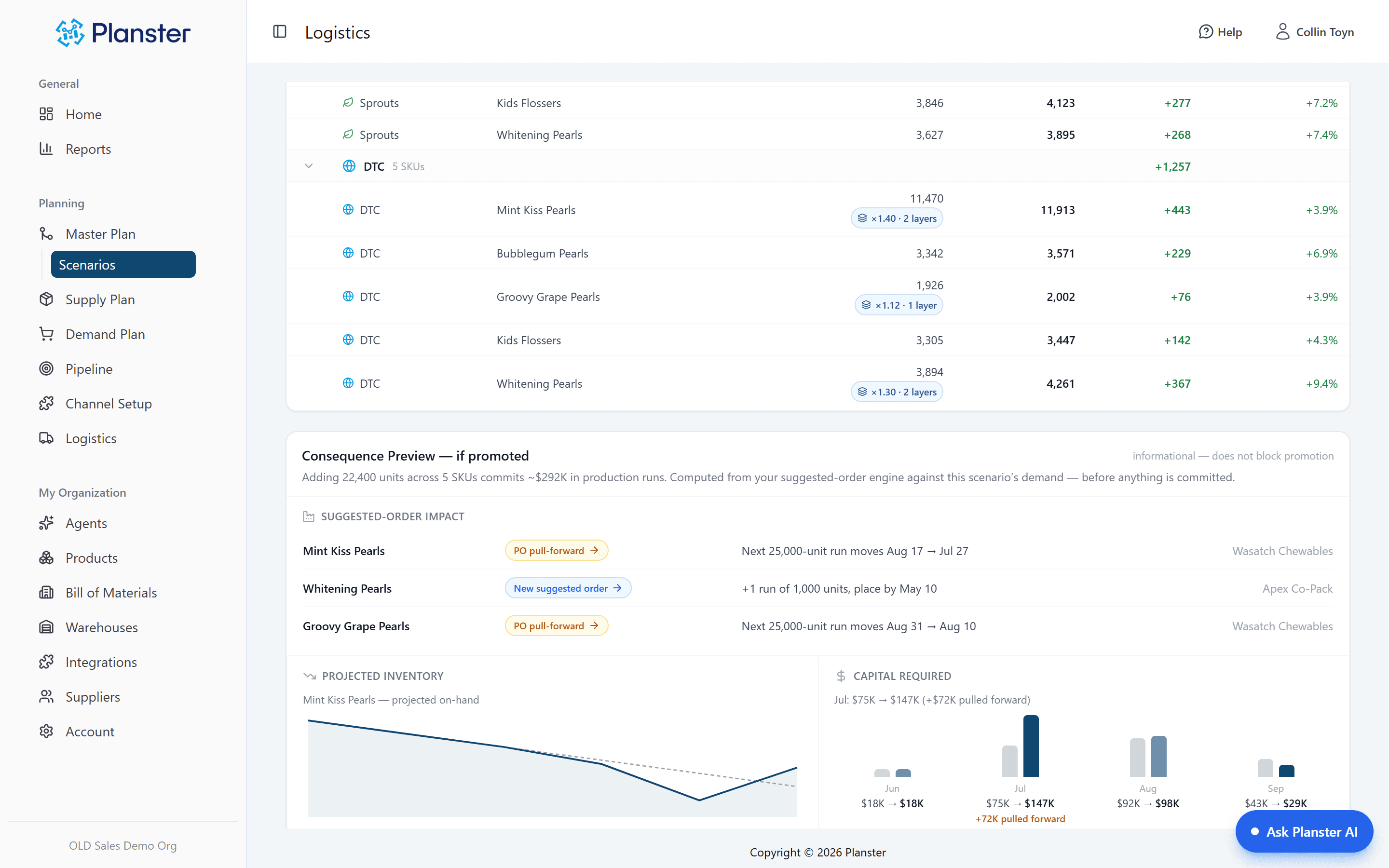
| Scenario planning with consequence preview | Sandbox what-ifs; see PO + capital impact before committing (~$292K); promote with version history + un-promote | Open-to-Buy budgeting and reorder suggestions; no what-if sandbox, no capital-consequence preview, no versioning |
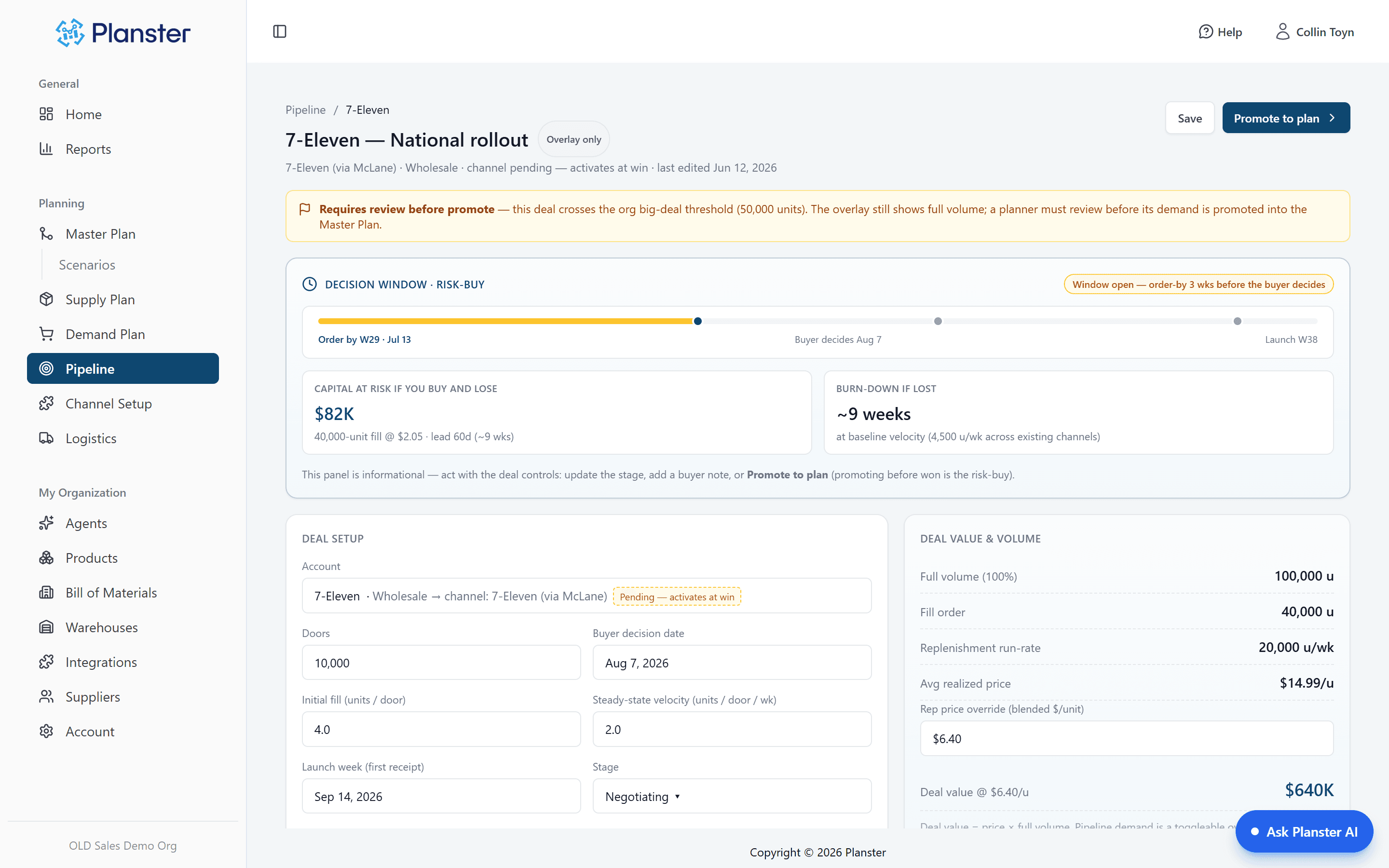
| Retail-deal pipeline → demand (risk-buy math) | Deals overlay the plan at full volume; tells you the order-by date and capital at risk if a deal falls through | Forecasts organic demand only; no retail-deal or sales-pipeline planning |
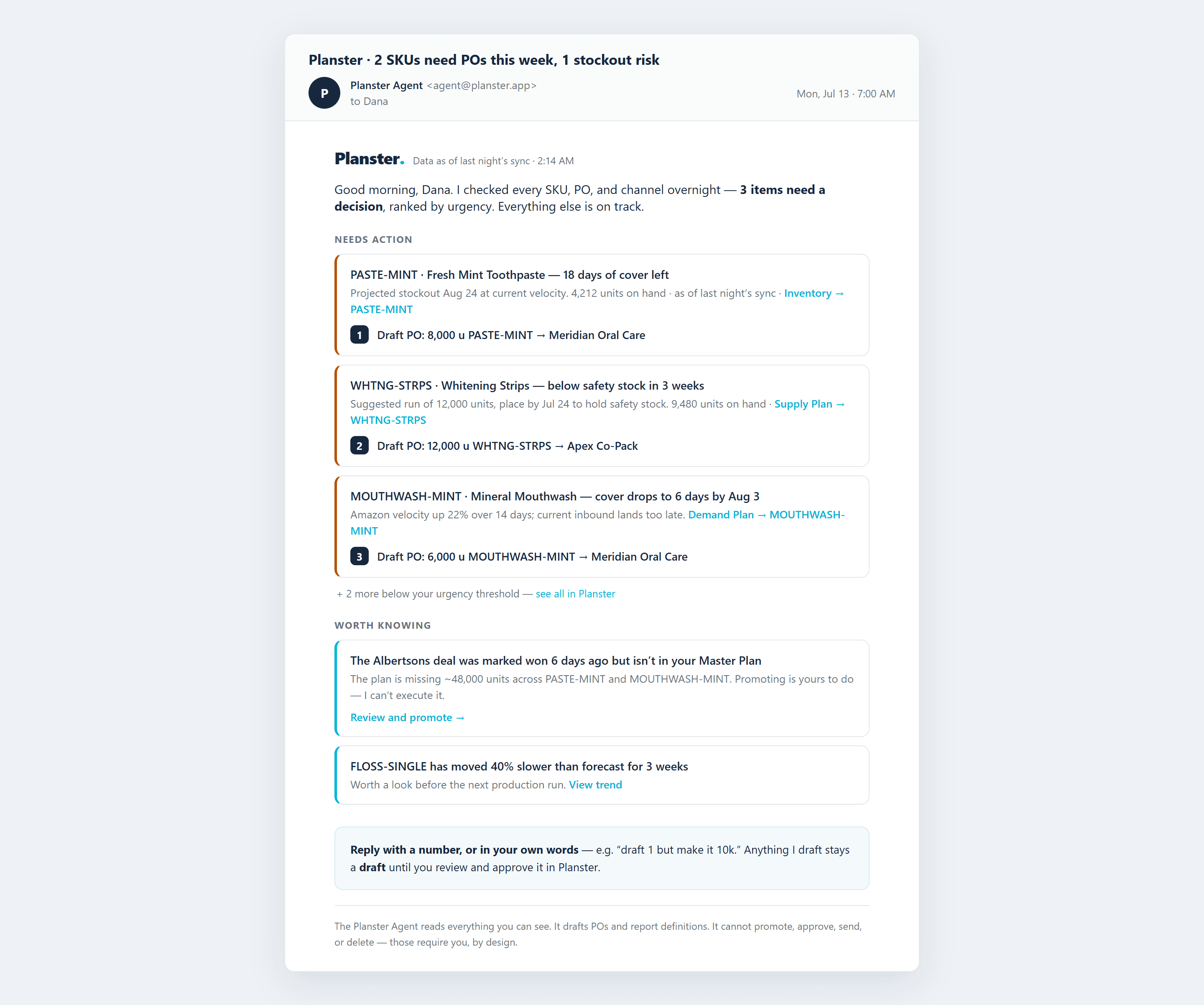
| AI agent | Overnight scan of every SKU/PO/channel → ranked morning digest email; reply in plain English to draft POs (draft-only, you approve) | Sage Copilot in-app advisor flags priority replenishments and late POs; human-in-the-loop, but no scheduled overnight digest or plain-English draft loop |
| Onboarding time | Fast — most brands run their first what-if on day one | Reported ~5–6 weeks guided onboarding (97% success claim) |
| Pricing model | Flat ~$1,000/mo — one predictable number that doesn't change when you have a good month | Priced against your revenue: the more you sell, the more you pay — on an annual contract, with real numbers hidden behind a sales quote (only the $119.99/mo Shopify-only entry tier is public). "Value for Money" is their lowest-rated dimension (4.4/5) |
| Integrations | 150+ integrations via Trackstar — WMS, 3PL, fulfillment, and every major sales channel (Shopify, Amazon, Walmart, TikTok, and more) — plus native accounting/ERP: Zoho and Luminous live today, with QuickBooks, Xero, NetSuite, and Sage rolling out | 50+ integrations |
| Reporting & dashboards | Build any custom report you need — and the AI agent can draft report definitions for you and flag what needs attention | Large library of prebuilt reports, plus Open-to-Buy budgeting |
| Platform maturity & track record | Newer, focused; purpose-built for consumable CPG | More established — larger install base (2,600+ brands) and years of edge-case coverage |
| Third-party review ratings | Newer to market — actively building its review base | G2 4.5/5 (~39 reviews), Capterra 4.6/5 (~66 reviews) |
Where Planster pulls ahead
See what a decision costs before you commit
Planster's Master Plan runs every what-if through your real ordering engine and shows the consequence — which POs move and how much capital the change pulls forward — before you say yes. Most planning tools tell you what to reorder; Planster tells you what a whole scenario commits.
Plan the retail launch, not just the reorder
Planster's Pipeline treats retail deals as living demand: a deal overlays your plan at full volume and does the risk-buy math — the order-by date to hit the launch, and the capital at risk if it falls through. That founder-level "do I buy before the buyer decides?" question is one a reorder tool never answers.
The grunt work happens overnight — the decision stays yours
Every night the Planster Agent checks every SKU, PO, and channel and emails a ranked morning digest with draft POs attached. Reply in plain English to draft; approve in the app. It cannot promote, approve, or send on its own — by design.
Pricing
Flat ~$1,000/month. One predictable number, no implementation fee, and it doesn't go up because you had a good quarter.
Priced as a function of your revenue — the more you sell, the more you pay, locked into an annual contract. Only the $119.99/month Shopify-only entry tier is public; every real tier is hidden behind a sales quote. It's no surprise "Value for Money" is their lowest-rated dimension on G2 and Capterra (4.4/5).
Competitor pricing verified against public sources and third-party estimates, 2026-07-23. Mid- and enterprise-tier figures are quote-gated and not published.
When Inventory Planner is the better fit
No tool wins for everyone. Here's where Inventory Planner is the honest choice.
- You want a large library of prebuilt reports out of the box rather than building your own custom ones.
- You need the most mature, established platform with years of edge-case coverage and built-in Open-to-Buy budgeting.
- You are a small Shopify-only brand where the $119.99/mo entry tier fits better than a flat mid-market price.
Common questions
Is Planster a full Inventory Planner replacement?
For $10–50M consumable CPG brands, yes — Planster provides forecasting, multi-channel and multi-warehouse planning, reorder recommendations, S&OP, BOM/kitting, and integrations, plus scenario planning, a retail-deal pipeline, and an AI agent on top. Very large or non-CPG retailers may prefer Inventory Planner's broader, more mature feature set.
How much does Planster cost vs Inventory Planner?
Planster is a flat ~$1,000/month with no implementation fee — the price is the same whether you have a slow month or a record one. Inventory Planner (by Sage) prices against your revenue on annual contracts: only its $119.99/month Shopify-only entry tier is public, and every higher tier is quote-gated and climbs as you grow.
Does Inventory Planner have an AI agent like Planster?
Inventory Planner offers Sage Copilot, an in-app AI advisor that flags priority replenishments and late POs with a human in the loop. It is not a scheduled overnight agent — Planster's agent scans every SKU, PO, and channel overnight and emails a ranked morning digest with draft POs you can trigger by replying in plain English (draft-only; you approve).
See the decision-first difference
Bring your gnarliest what-if or retail launch. Most brands run their first scenario on day one.